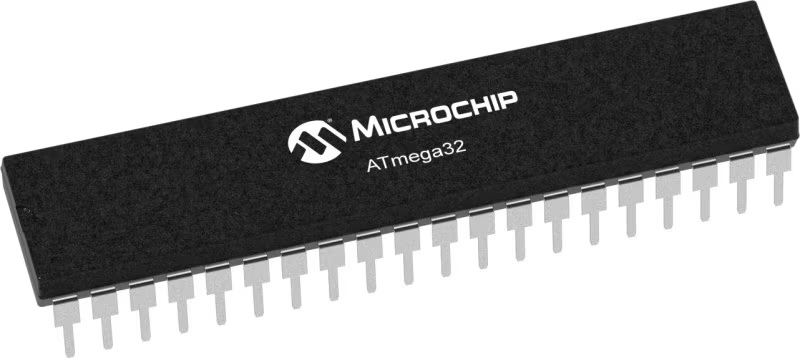
Notes#
Expressions#
Expression |
meaning |
|---|---|
DDR |
Data Direction Register |
ADC |
Analog to Digital converter |
avrdude useful commands#
reason |
command |
|---|---|
upload to Atmega32 |
|
set low fuse ATmega32 |
|
set high fuse bit ATmega32 |
|
Control global interrupts#
function |
action |
|---|---|
|
enable global interrupts |
|
disable global interrupts |
Interrupt#
GICR#
GICR stands for General Interrupt Control Register.
bit |
7 |
6 |
5 |
4 |
3 |
2 |
1 |
0 |
|---|---|---|---|---|---|---|---|---|
name |
INT1 |
INT0 |
INT2 |
- |
- |
- |
IVSEL |
IVCE |
Read/Write |
R/W |
R/W |
R/W |
R |
R |
R |
R/W |
R/W |
initial value |
0 |
0 |
0 |
0 |
0 |
0 |
0 |
0 |
To enable Interrupt1 to work we put the value of the 7th index of GICR to 1,
to do so we can use a code like this:
GICR |= 1 << INT1;
MCUCR#
MCUCR stands for MCU Control Register.
ISC stands for Interrupt Sense Control.
It basically controls when should an Interrupt occur.
As you can see we can config our Interrupt to happen in different situations.
bit |
7 |
6 |
5 |
4 |
3 |
2 |
1 |
0 |
|---|---|---|---|---|---|---|---|---|
name |
SE |
SM2 |
SM1 |
SM0 |
ISC11 |
ISC10 |
ISC01 |
ISC00 |
Read/Write |
R/W |
R/W |
R/W |
R/W |
R/W |
R/W |
R/W |
R/W |
initial value |
0 |
0 |
0 |
0 |
0 |
0 |
0 |
0 |
ISC11 |
ISC10 |
Description |
figure |
|---|---|---|---|
0 |
0 |
The low level of INT1 generates an interrupt request. |
|
0 |
1 |
Any logical change on INT1 generates an interrupt request. |
|
1 |
0 |
The falling edge of INT1 generates an interrupt request. |
|
1 |
1 |
The rising edge of INT1 generates an interrupt request. |
|


ISC01 |
ISC00 |
Description |
figures |
|---|---|---|---|
0 |
0 |
The low level of INT0 generates an interrupt request. |
|
0 |
1 |
Any logical change on INT0 generates an interrupt request. |
|
1 |
0 |
The falling edge of INT0 generates an interrupt request. |
|
1 |
1 |
The rising edge of INT0 generates an interrupt request. |
|
MCUCSR#
MCUCSR stands for MCU Control and Status Register.
The only thing that we should know in this table is ISC2.
This register can handle how interrup2 will be triggerd
(Falling edge or rising edge).
bit |
7 |
6 |
5 |
4 |
3 |
2 |
1 |
0 |
|---|---|---|---|---|---|---|---|---|
name |
JTD |
ISC2 |
- |
JTRF |
WDRF |
BORF |
EXTRF |
PORF |
Read/Write |
R/W |
R/W |
R |
R/W |
R/W |
R/W |
R/W |
R/W |
initial value |
0 |
0 |
0 |
depends |
depends |
depends |
depends |
depends |
GIFR#
GIFR stands for General Interrupt Flag Register.
When an interrupt happens, a corresponding index of
this register will be set to 1.
If we write 1 to any of the indexes manually, we
can clear the flag.
bit |
7 |
6 |
5 |
4 |
3 |
2 |
1 |
0 |
|---|---|---|---|---|---|---|---|---|
name |
INTF1 |
INTF0 |
INTF2 |
- |
- |
- |
- |
- |
Read/Write |
R/W |
R/W |
R/W |
R |
R |
R |
R |
R |
initial value |
0 |
0 |
0 |
0 |
0 |
0 |
0 |
0 |